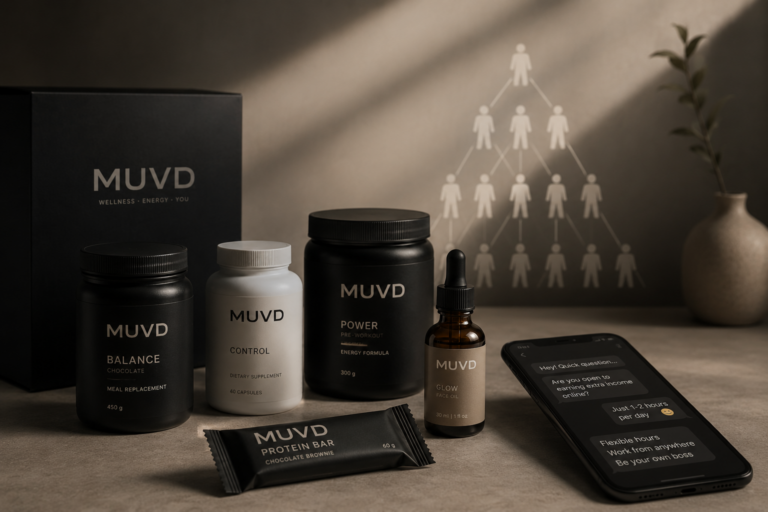

Not all multi-level marketing is the same. That is a statement that will surprise some readers of this platform, and it is worth saying clearly at the outset: the problems with modern MLM are real and well-documented, but understanding how the model has changed over the past seventy years matters if you want to understand why today’s version is structurally more dangerous than what came before.
This piece is a history. It traces how direct sales evolved from the postwar home party model into the social-media-driven recruitment culture of IM Academy and forex influencers. It is also an argument: that the shift from product-focused selling to recruitment-focused lifestyle marketing represents something qualitatively different, not just a louder version of the same thing.
Where it started: a bowl, a party, and a woman who needed income
In 1946, a chemist named Earl Tupper began selling airtight plastic food containers in American stores. They did not sell. Americans in the late 1940s did not yet trust plastic, which carried associations with cheap, greasy wartime materials. The product sat on shelves.
The solution came not from Tupper but from a single mother and former sales representative named Brownie Wise. She had been selling Tupperware through home demonstrations and noticed that the product made far more sense when someone showed you how the seal worked than when you picked it up in a store. Tupper noticed her sales numbers and in 1951 made her vice president of marketing. Wise then built one of the most distinctive sales models in American commercial history: the Tupperware party.
The model was simple. A woman hosted a gathering in her home. She demonstrated the containers, served food, played games. Her guests could buy directly. If they wanted to host their own party and earn a commission, they could sign up as a dealer. In 1954, Wise became the first woman to appear on the cover of Business Week.
What made the Tupperware model work, and what made it different from what would come later, was its relationship to the product. The containers were the point. They were genuinely innovative for their time, durable, well-designed, and the home party format existed because the product needed demonstration to be understood. Recruiting new dealers was part of the model, but it was secondary. The party was not a recruitment event with plastic containers as a cover story. It was a product demonstration that also offered women, at a time when their economic opportunities were severely limited, a legitimate way to earn income.
One 1960s Tupperware advertisement, preserved at the National Museum of American History, promised dealers they could “add $40 to $60 a week to your family income” (roughly $420 to $630 per week in 2026). That is a supplementary income claim, not a promise of financial freedom or passive wealth. The gap between those two things matters enormously.
Avon, Amway, and the expansion of the model
Tupperware was not alone. The same postwar decades saw the rise of Avon, which had been operating since 1886 but expanded rapidly in the 1950s and 1960s through a similar model of women selling beauty products to neighbors and acquaintances. And in 1959, two Nutrilite distributors named Jay Van Andel and Rich DeVos founded Amway, selling a cleaning product through a commission structure that would become the template for the modern MLM compensation plan.
Amway’s structure was more aggressive about recruitment than Tupperware’s had been, and it attracted regulatory scrutiny almost immediately. In 1975, the Federal Trade Commission filed a complaint alleging that Amway was operating an illegal pyramid scheme. The FTC’s 1979 ruling found that Amway was not a pyramid scheme, based on three safeguards the company had in place: a rule requiring distributors to sell at least 70% of previously purchased inventory before ordering more, a rule requiring retail sales to at least ten different customers each month, and a rule allowing distributors to return unsold products. These three rules established the legal framework that has defined the boundary between legitimate MLM and illegal pyramid scheme in the United States ever since.
The important thing to understand about that framework is what it protects against: a model in which money flows primarily from new recruits to older ones, with no genuine product sales to external consumers. Amway’s safeguards were designed to ensure that real selling happened. Whether those rules were enforced in practice is a separate and contested question, but the principle they embodied is a meaningful one. A direct sales organization that genuinely focuses on moving products to external customers at competitive prices is doing something different from one that focuses primarily on recruitment.
For most of the next four decades, the MLM industry operated in the space those rules defined. Products were central, at least in theory. Herbalife sold weight management supplements. Avon sold cosmetics. Amway sold cleaning products and later a sprawling range of household goods. The pitch to new distributors emphasized income from sales, with recruitment as an additional income stream on top.
What changed: the internet, the pandemic, and the side hustle era
The first significant shift came with the internet in the late 1990s and early 2000s. Distributors could now prospect and sell online, reaching far beyond their immediate social circle. The warm market of family and friends was no longer the ceiling. This expanded the potential pool but also began to change the nature of the relationship between recruiter and recruit. The personal trust of a neighbor recommending a product at a kitchen table gave way to stranger-to-stranger outreach through social networks.
The second shift was slower and cultural. The 2008 financial crisis and its long aftermath produced a generation of young adults who were economically anxious, skeptical of institutional employment, and actively looking for alternatives. The language of “side hustle,” “passive income,” and “financial freedom” filled that space. According to a 2024 survey by Bankrate, nearly two-thirds of Americans aged 18 to 35 had started or planned to start a side hustle alongside other income. An Intuit survey from the same period found that 57% of Gen Z reported at least one side hustle, compared to 52% of millennials.
MLM stepped directly into that cultural moment. The language of entrepreneurship, independence, and building your own income stream that had always been part of the MLM pitch became even more resonant when the mainstream economy appeared to be failing young people. But the products were no longer the center of the pitch. The lifestyle was.
The third shift was social media. TikTok, Instagram, and YouTube did not just give MLM distributors a new channel. They created a new aesthetic for what success looked like, and a new set of conventions for how products and opportunities were marketed. The “day in my life” video, the morning routine, the candid shot from a business trip abroad: these formats made it natural to weave commercial pitches into what looked like personal content. As one analysis of the current MLM landscape put it, instead of a direct recruitment message, you now see videos titled “5 ways I make passive income” or “My side hustle pays my rent,” with an MLM pitch nestled alongside freelancing and dropshipping as though they were equivalent options.
The forex turn: when the product disappeared entirely
The clearest example of where this evolution leads is not a wellness supplement company or a cosmetics brand. It is IM Academy.
IM Academy was founded in New York in 2013 by Christopher Terry, a former Amway sales manager, and his wife Isis Terry. It sells online educational courses about forex trading, cryptocurrency, and financial markets. The monthly membership fee is $250. Members can have that fee waived if they recruit two new members. If they recruit three or more, they begin earning commissions.
What IM Academy sells is not a physical product. It sells access to videos and webinars about trading. Whether those materials teach anything of genuine value is one question. But the deeper structural question is what the business model is actually built on. When the FTC and the Nevada Attorney General filed a complaint against IM Academy’s founders in May 2025, they alleged that the company had operated a scheme in which most participants made little or no money from trading, that instructors had no formal financial education, and that total consumer losses since 2018 exceeded $1.2 billion. The complaint stated that the organization had disproportionately targeted young African-Americans and Latinos in the United States.
The promotional strategy, the FTC alleged, relied heavily on aspirational lifestyle marketing: posts on Instagram and TikTok showcasing luxury cars, international travel, and financial independence. In the Netherlands, a Zeist.NU investigation found exactly this pattern: young members sending unsolicited Instagram messages to strangers, inviting them to presentations where Croatia trip videos and Mexico hotel promises were deployed before any discussion of what the company actually was.
In Belgium, IM Academy has been convicted of fraud and operating a pyramid scheme. In Luxembourg, employees were arrested during an investigation in 2023. The company rebranded as IYOVIA in November 2024, a move that critics noted was consistent with a pattern of name changes used to outrun regulatory reputations.
The contrast with Tupperware is stark. Brownie Wise built a sales force around a product that needed demonstration. IM Academy built a recruitment network around a lifestyle that needed to be performed.
The difference that matters
It would be too simple to say that old MLM was fine and new MLM is not. Tupperware was an MLM. It had a pyramid structure. The women at the top of that structure earned significantly more than those below. There was always a concentration of income at the apex, and the 1960s promise of $40 to $60 per week was real for some and elusive for others.
But there are genuine differences that matter for anyone trying to evaluate whether a particular opportunity is what it claims to be.
The first difference is the relationship between recruitment and selling. In a model where external product sales drive revenue, distributors have an incentive to find genuine customers. The product has to be competitive enough to sell to people who are not themselves trying to make money from the company. That constraint disciplines the model. In a model where recruitment is the primary source of income, the product is incidental. It exists to provide legal cover, not to generate value.
The second difference is the nature of the promise. The Tupperware advertisement promised $40 to $60 per week as a supplement to household income. Modern recruitment-focused MLM, and particularly the forex and crypto-adjacent companies, promises financial freedom, passive income, and a life of luxury travel and expensive cars. The gap between a supplementary income claim and a financial freedom claim is enormous, and it maps directly onto the gap between a product-focused model and a recruitment-focused one. You can realistically earn a modest supplementary income from selling products people want to buy. You cannot realistically achieve financial freedom through a recruitment structure that mathematically guarantees most participants will lose money.
The third difference is visibility. The Tupperware party happened in someone’s living room, with people who knew each other, and the host was a recognizable neighbor. The Instagram DM arrives from a stranger, often using language that obscures the commercial nature of the contact entirely until the listener is already engaged. The social context that once provided some natural friction, the awkwardness of pushing too hard on a friend, is replaced by a digital environment designed to lower resistance and move fast.
Claudia Groß, Assistant Professor at Radboud University Nijmegen, whose research on MLM structures has been cited throughout this series, draws the distinction clearly in her 2023 overview: the question is not whether a company has a multilevel compensation structure, many legitimate direct sales organizations do, but whether the primary economic activity is retail sales to external consumers or the continuous recruitment of new participants who pay to join.
By that measure, Tupperware at its peak was closer to the legitimate end of the spectrum than most of what has followed it. IM Academy, with its $1.2 billion in alleged consumer losses, is at the other end entirely.
What this means for how you evaluate an opportunity
When someone invites you to learn about a business opportunity, a few questions cut through most of the noise.
What is the product, and would anyone buy it if they were not trying to make money from the company? If the honest answer is that most customers are also participants, the model is not built on genuine product demand.
What does the income disclosure actually say? Not the testimonial on stage, not the lifestyle content on Instagram, but the official income disclosure statement, including everyone who participated, not just those who earned something.
Is the promise supplementary income or financial freedom? The first is occasionally achievable. The second, in a recruitment-driven model, is mathematically available to a tiny minority and structurally unavailable to most. The bigger the promise, the more carefully the structure deserves to be examined.
The party in someone’s living room has moved to a DM in your phone. The bowl has been replaced by a trading course, a wellness supplement or a lifestyle membership. But the underlying question has not changed: is the product the point, or is recruitment?
Sources
National Museum of American History. Parties for plastic: How women used Tupperware to participate in business. https://americanhistory.si.edu/explore/stories/parties-plastic-how-women-used-tupperware-participate-business
CNN Business (April 13, 2023). So this is how the Tupperware party ends. https://www.cnn.com/2023/04/13/business/tupperware-history/index.html
MLMinfopages.com (March 15, 2026). The history of multi-level marketing: From 1940s to today. https://mlminfopages.com/blog/the-history-of-multi-level-marketing-from-1940s-to-today
Intuit Blog (November 2025). The side hustle generation: Gen Z and millennials redefine financial success. https://www.intuit.com/blog/innovative-thinking/the-side-hustle-generation/
Medium / Margins and Mainstream (October 2025). From “Hey Girl” to Hashtag Hustle: MLM’s evolution from the 2010s to 2025. https://medium.com/@hellokarenlobo25/from-hey-girl-to-hashtag-hustle-mlms-evolution-from-the-2010s-to-2025-1a8559d2fc14
Wikipedia. IM Academy. https://en.wikipedia.org/wiki/IM_Academy
Consumer Affairs (August 8, 2025). FTC cracks down on IM Mastery Academy founders in $1.2 billion fraud case. https://www.consumeraffairs.com/news/ftc-cracks-down-on-im-mastery-academy-founders-in-12-billion-fraud-case-080825.html
Zeist.NU (2024). Jongeren in de val door piramidespel: overheid doet niets. https://www.zeist.nu/jongeren-in-de-val-door-piramidespel-overheid-doet-niets/
Groß, C. and Martin, H. (2023). MLM Explained: The facts about multi-level marketing, network marketing, and direct selling. Radboud University Nijmegen / Talented Ladies Club. https://hdl.handle.net/2066/290373
Exit the Pyramid is an independent research and journalism platform investigating MLM structures, online recruitment tactics, and the regulation gap that allows them to operate. Founded in the Netherlands.
If you have a personal account or tip related to any of the organizations covered on this platform, you can reach us at info@exitthepyramid.org
About the Author